


ROJAVA
Rise and Dismantling of a Kurdish Political Experiment in Syria
2/18/20267 min read
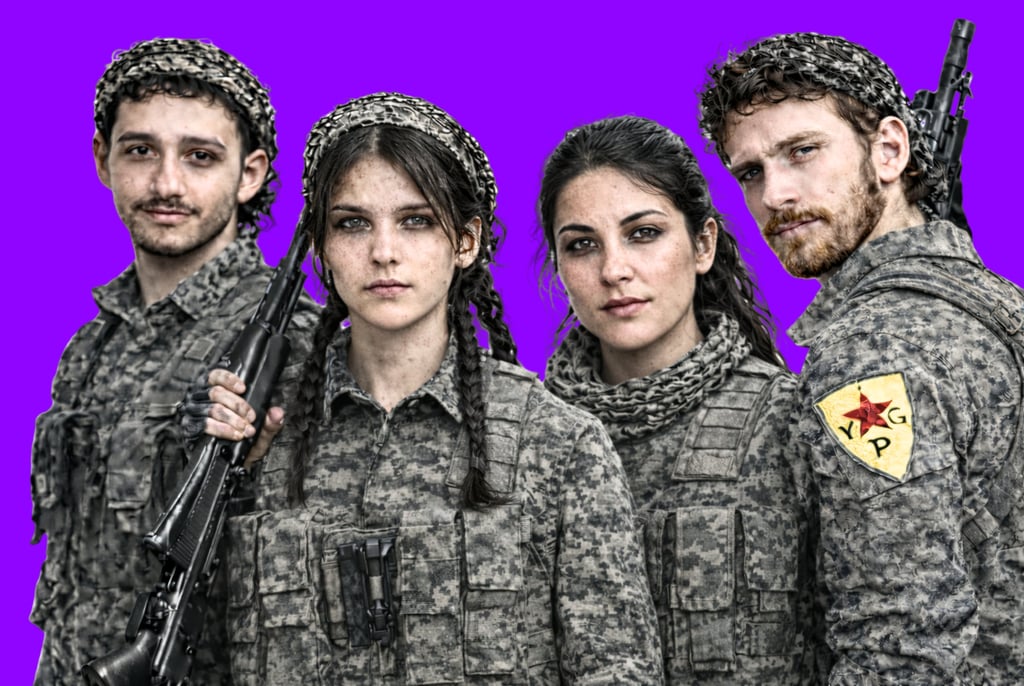
1. An Offshoot of the PKK in Syria
The roots of Rojava (“West” in Kurdish) are directly linked to the PKK (Kurdistan Workers’ Party), founded in 1978 by Abdullah Öcalan in Turkey. Initially Marxist-Leninist in orientation, the party began an armed struggle against the Turkish state in 1984 and sought the creation of an independent Kurdish state. After Abdullah Öcalan’s arrest in 1999, the PKK underwent an ideological transformation. Influenced by the writings of Murray Bookchin, Öcalan abandoned the goal of an independent Kurdish state and developed the concept of “democratic confederalism,” based on local self-governance, direct democracy, gender equality, and a multiethnic model. The group is listed as a terrorist organization in Turkey, the United States, and by the European Union.
The Kurdish question in Syria is longstanding and structural. In October 1962, an exceptional census was conducted in the governorate of al-Hasakah. Around 120,000 Kurds were stripped of their Syrian nationality, accused of being “foreigners.” They were classified as ajanib (registered foreigners) or maktoumin (unregistered). This decision deprived entire generations of civil rights: the inability to vote, hold public-sector jobs, legally purchase land, or obtain official documents. During the 1980s and 1990s, the Syrian regime tolerated the PKK’s presence on its territory, mainly to exert pressure on Ankara. This situation ended in 1998, when Hafez al-Assad expelled the PKK under Turkish military threat. The organization then withdrew to the Qandil Mountains in northern Iraq.
In Syria, the PYD (Democratic Union Party) was officially founded in 2003. Ideologically aligned with the PKK and Abdullah Öcalan, it operated clandestinely under Bashar al-Assad’s regime. Most PYD leaders had been PKK members in the 1990s. Led by Salih Muslim Muhammad, the PYD gradually built a local militant apparatus (networks, cadres, civil structures), allowing it to be immediately operational during the 2011 uprising and to quickly establish itself as the dominant actor in Kurdish-majority regions.
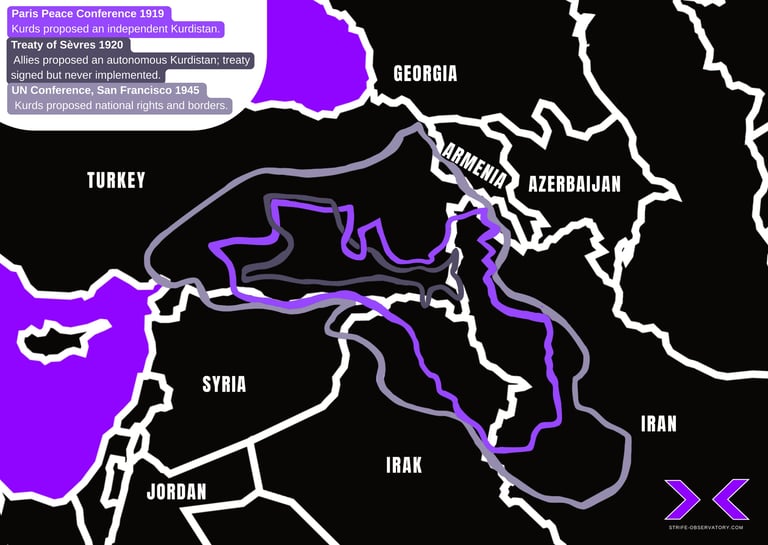
Cartographic representation of projects to establish a Kurdish state between 1919 and 1945; source: Kurdish Institute of Paris.
Cartographic representation of projects to establish a Kurdish state between 1919 and 1945; source: Kurdish Institute of Paris.
2. From the Syrian Uprising to Territorial Peak (2011–2018)
On March 15, 2011, the Syrian uprising began in Deraa. Kurdish youth supported the protests, detached from communal considerations. The PYD feared that a rapid fall of the regime would result in a government dominated by Islamist groups backed by Turkey and the Gulf monarchies. Between 500 and 1,000 PKK fighters from Mount Qandil joined the PYD’s armed forces at that time. Meanwhile, other Kurdish parties attempted to organize themselves. In October 2011, under the initiative of Massoud Barzani, President of Iraqi Kurdistan, the Syrian Kurdish National Council (CNKS) was created. The aim of this council was to unite around a dozen Syrian Kurdish parties in order to organize the administration of controlled areas and to counterbalance the PYD’s dominance.
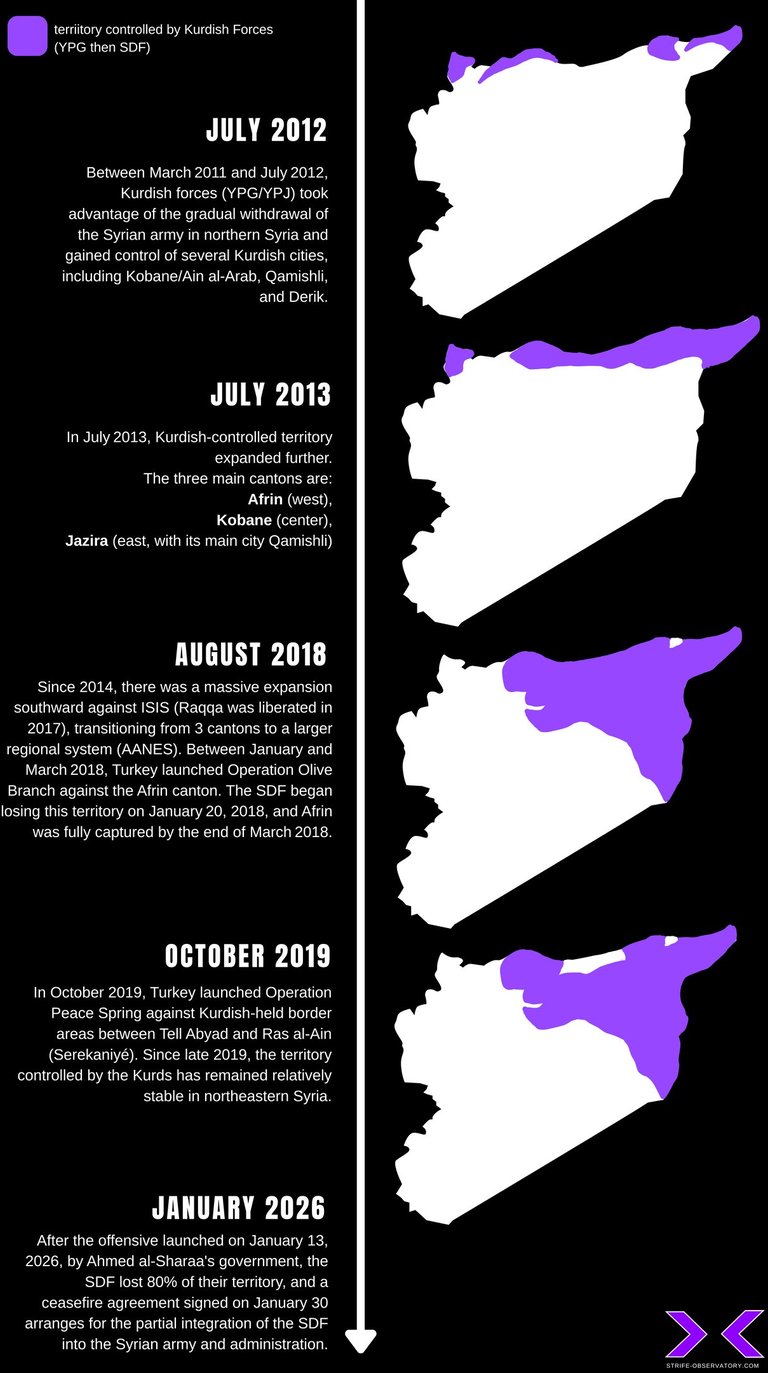
In the summer of 2012, the regime withdrew part of its forces from the northeast to concentrate its troops around Damascus. A pragmatic alliance emerged between the regime and the Kurds, who had an interest in the survival of a weakened Assad regime. The PYD and its armed forces, the YPG (People’s Protection Units) and its female branch, the YPJ (Women’s Protection Units), took control of most Kurdish cities: Afrin, Kobane, and the Jazira region around Qamishli. Rojava became a territorial reality. Under this governance, other political parties were excluded from the decision-making mechanism and sometimes silenced. The Erbil agreements that same year sought to unify Kurdish forces by sharing control of Rojava. However, the balance remained fragile. The PYD gradually imposed itself as the dominant actor thanks to its military strength. Internal rivalries intensified and the rupture became clear at the end of 2013. The CNKS began negotiations in Istanbul with the Syrian opposition to join the Syrian National Council. At the same time, the PYD announced that Rojava had its own autonomous administration and was organized into three cantons: Jazira, Kobane, and Afrin, each with its own local legislative assembly. The political model claimed local democratic self-governance, political ecology, anti-capitalism, minority representation, and strong female participation.
The year 2014 also marked a military turning point. In the autumn, the Battle of Kobane against the Islamic State organization drew international attention. The YPG resisted with the air support of the U.S.-led coalition. An alliance with Arab tribes and certain Free Syrian Army groups called itself the “Euphrates Volcano,” a precursor to the SDF. The Syrian Democratic Forces (SDF) were created on October 10, 2015, in Hasakah. By the end of 2015, they claimed 40,000 fighters, including 35,000 YPG/YPJ members. In March 2017, U.S. General Stephen Townsend stated that the composition had shifted to 40% Kurds and 60% Arabs. Depending on the period and sources (2015–2020), estimates ranged between 40,000 and 100,000 fighters.
Territorial expansion was rapid. Raqqa was taken from ISIS in 2017. The vast northeastern Syrian region controlled by the SDF included the country’s major oil and gas fields (Al-Omar, Al-Tanak, Koniko, Al-Jafra), which before the war represented around 70% of national reserves. A commercial agreement between Delta Crescent Energy and the SDF administration was concluded to exploit these fields; this agreement was denounced as a “looting” by Bashar al-Assad’s former regime. On March 23, 2019, after the fall of Baghouz, they announced 11,000 dead and 21,000 wounded over five years of war against ISIS,
The SDF managed a network of camps and prisons in northeastern Syria housing thousands of detainees linked to ISIS, including women, men, and children, with children often separated from their mothers to limit indoctrination and many having grown up exclusively in detention. The main camps were Al-Hol, which hosted up to 70,000 people in 2019 and around 25,000 in early 2025, with more than 60% children, and Roj, with approximately 2,200–2,600 people of multiple nationalities. Male detention centers held around 8,500 men, including 5,400 Syrians and 3,100 foreigners, among them 1,600 Iraqis. Human rights organizations reported harsh conditions, lack of access to essential services, and detention without formal trial, particularly in Al-Hol. Human Rights Watch estimated that around 80% of the children in Al-Hol and Roj camps were under the age of 12. Amnesty International denounced the prolonged detention of children in unsanitary camps in northeastern Syria, the lack of access to education and healthcare, and the serious psychological and social risks faced by these minors. The NGO also highlighted the absence of judicial procedures for detained adults and the extremely precarious living conditions in camps and prisons.
3. The Turkish Offensive, Territorial Losses and Disintegration (2018–2026)
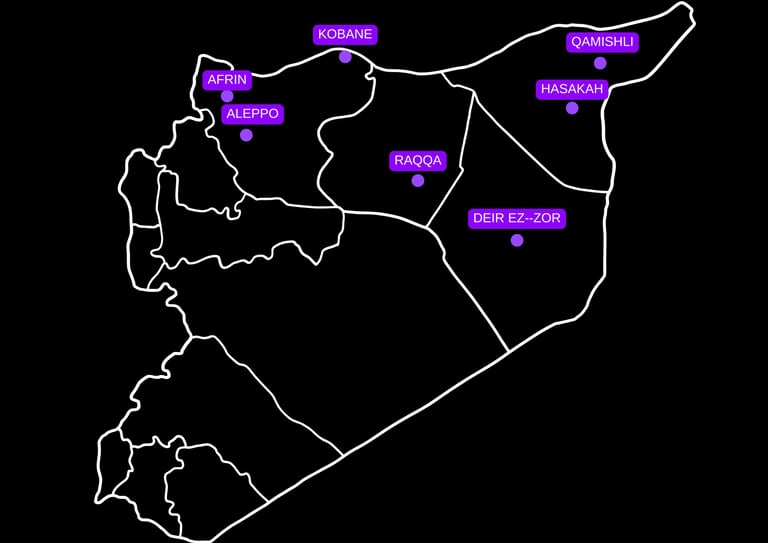
In January 2018, Turkey launched “Operation Olive Branch” against the canton of Afrin (northwestern Syria), a predominantly Kurdish area, targeting the YPG, which Ankara considers an extension of the PKK. The offensive, conducted by the Turkish army and the Syrian National Army (SNA) (a coalition of pro-Turkish Syrian militias), resulted in the capture of Afrin in March 2018 and the forced displacement of tens of thousands of Kurdish civilians. This marked a major loss for Rojava: Afrin was no longer under SDF/YPG control and came under Turkish influence and allied militias.
In 2019, Trump announced his intention to withdraw all U.S. troops from Syria, considering that the territorial defeat of ISIS fulfilled American objectives in the region. The Pentagon and the State Department moderated this decision, and 900 of the 2,500 troops remained alongside the SDF. Turkey took advantage of this to launch “Operation Peace Spring” against Kurdish forces. This offensive targeted a border strip approximately 32 km deep along the Syrian frontier between Tal Abyad and Ras al-Ain (northeastern Syria), leading to the withdrawal of Kurdish fighters from these sectors following a ceasefire negotiated by Washington. Turkey justified these operations by viewing the YPG as a direct threat to its security and sought to establish buffer zones along its border.
Faced with these military pressures, the Autonomous Administration of North and East Syria (AANES) had to negotiate with Damascus and Moscow to stabilize the situation and prevent a broader Turkish advance. Syrian regime troops re-entered certain border areas previously under Kurdish control, significantly altering the balance of power.
After the fall of Bashar al-Assad in December 2024 and the capture of Damascus by Hayat Tahrir al-Sham, the new authorities demanded the integration of all armed factions into the state. On March 10, 2025, an agreement was signed in Damascus between Ahmed al-Charaa and the commander of the Syrian Democratic Forces, Mazloum Abdi. It provided for a national ceasefire, the gradual integration of civil and military institutions in the northeast (including border crossings, airports, and oil and gas fields) under central authority by the end of 2025, and the guarantee of Kurdish political representation. However, implementation remained fragile: clashes broke out in Aleppo on October 6–7, 2025, quickly halted after a new meeting between Charaa and Abdi. The agreement was never fully implemented due to ambiguity surrounding the administration of Kurdish areas and control over hydrocarbon resources.
The offensive against Rojava’s Kurdish forces was launched by the Syrian government on January 13, 2026, initially in the Aleppo governorate and then extended on January 17 to Raqqa, Deir ez-Zor, and Hasakah. The SDF rapidly lost around 80% of their territory following the defection of numerous Arab units. Under pressure, a ceasefire agreement was announced on January 18, followed by a comprehensive agreement signed on January 30, 2026, providing for the gradual integration of Kurdish forces and institutions into the Syrian state and the cessation of hostilities. Government forces were deployed in cities such as Hasakah and Qamishli in early February. Rojava no longer exists as a de facto autonomous zone, although certain residual areas remain under PYD influence without an independent political structure.
sources :
https://www.amnesty.fr/actualites/syrie-enfants-de-daech-rapatriement-la-chronique/
Rojava, Magda Tagtachian
Revolution in Rojava, Michael Knapp, Anja Flach, Ergan Ayboga
The PKK coming down from the mountains, PAUL WHITE
Histoire de la Syrie, Xavier Baron