

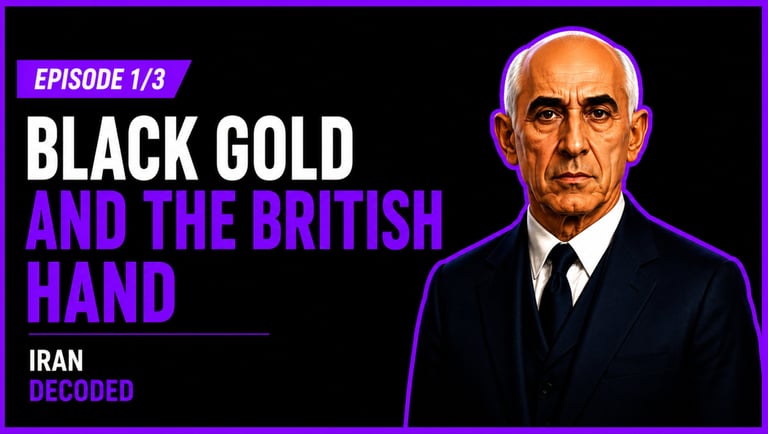
Iran Decoded (1/3)
BLACK GOLD AND THE BRITISH HAND (1901–1953)
6/6/20269 min read
I. Iran Under Foreign Domination (1789–1925)
To understand the twentieth century, we must go back to 1789. That year, Agha Mohammad Khan, leader of the Turkoman Qajar tribe, unified a fragmented Persia after decades of civil war. Crowned Shah (King) in Tehran in 1796, a city he chose as his new capital. He founded the Qajar dynasty, which would rule until 1925. He was assassinated the following year, however, leaving behind a monarchy that appeared strong in form but remained fragile in reality.
Throughout the nineteenth century, Iran gradually lost its sovereignty. Defeated by Russia in two successive wars (1804–1813 and 1826–1828), the country ceded Armenia, Georgia, Dagestan, and Azerbaijan. The Treaty of Turkmenchay, signed in 1828, imposed the first system of capitulations on Iran extraterritorial privileges granted to Russian subjects on Persian soil, including exemption from Iranian courts, tax immunity, and the right to be tried in consular courts. In the decades that followed, Britain demanded and obtained the same privileges. For more than a century, Iranians regarded these concessions as a profound national humiliation.
It was against this backdrop of a weakened state that the aging and heavily indebted Shah, Mozaffar al-Din, received a British envoy at his palace in 1901.
II. The D'Arcy Concession
William Knox D'Arcy was a wealthy English businessman whose fortune had been made in an Australian gold mine. In search of a new investment, he turned his attention to Persia. In March 1901, his representative, Alfred Marriott, arrived in Tehran.
On May 28, 1901, at the Sahebgharaniyeh Palace, the Shah signed an eighteen-point agreement granting D'Arcy the exclusive rights to explore, extract, transport, and sell petroleum, natural gas, asphalt, and mineral waxes throughout Iran for a period of sixty years. The concession covered approximately 1.24 million square kilometers roughly three-quarters of the country.
In return, the Shah received £20,000 in cash, another £20,000 in company shares, and a promise of 16 percent of the company's net profits. D'Arcy himself would never set foot in Iran, and years would pass before oil was finally discovered.
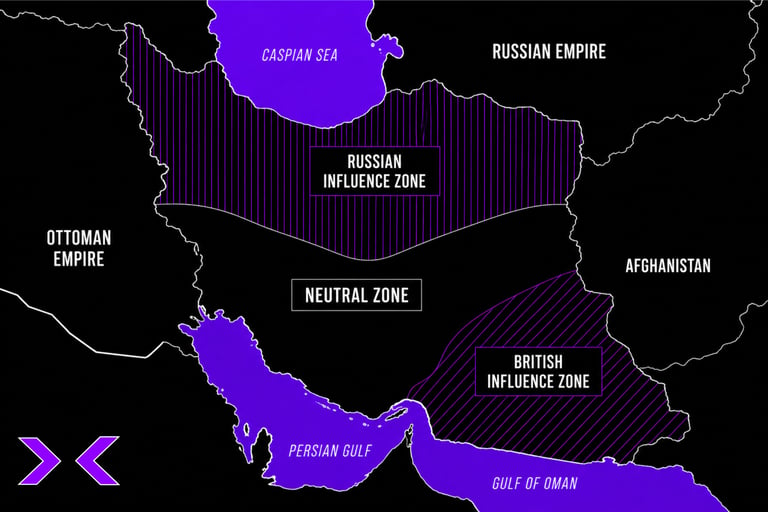
On August 31, 1907, Britain and Russia signed the Anglo-Russian Convention in Saint Petersburg without consulting Tehran. The agreement divided Iran into three spheres of influence: the north including Tehran and Isfahan fell under exclusive Russian influence; the southeast including Kerman and Bandar Abbas became an exclusive British sphere; and between them lay a neutral buffer zone where both powers were free to compete.
The Iranian government learned of the agreement only after it had been signed. It refused to recognize the treaty but lacked the means to oppose it.
III. 4:00 A.M., May 26, 1908
Seven years of relentless work in the desert. Engineer George Reynolds drilled under brutal conditions, facing smallpox, bandit attacks, and temperatures reaching 50°C (122°F). By then, D'Arcy had exhausted his fortune.
In May 1908, his financiers sent a telegram with a simple instruction:
"Stop all operations. Return home."
Reynolds delayed.
At 4:00 a.m. on May 26, 1908, a fifteen-meter geyser of oil erupted at Masjed Soleyman.
It was the first major oil discovery in the Middle East.
It would change everything.
In April 1909, the Anglo-Persian Oil Company (APOC) was established. By 1912, its refinery at Abadan had become the largest in the world. Two years later, Winston Churchill persuaded the British government to acquire a 51 percent stake in the company. Iranian oil became the fuel that powered the Royal Navy.
Iran did receive the promised 16 percent share of the profits, but APOC manipulated the accounting. Auditors commissioned by Tehran would later prove it.
IV. The Rise of the Pahlavis
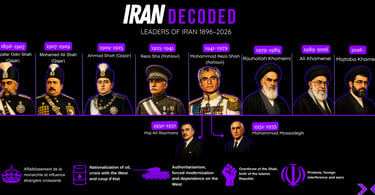
By 1921, Iran was on the verge of collapse. The First World War had left the country occupied simultaneously by British, Russian, and Ottoman forces. Ahmad Shah, the last Qajar ruler, was in Europe seeking medical treatment. The provinces had become virtually ungovernable.
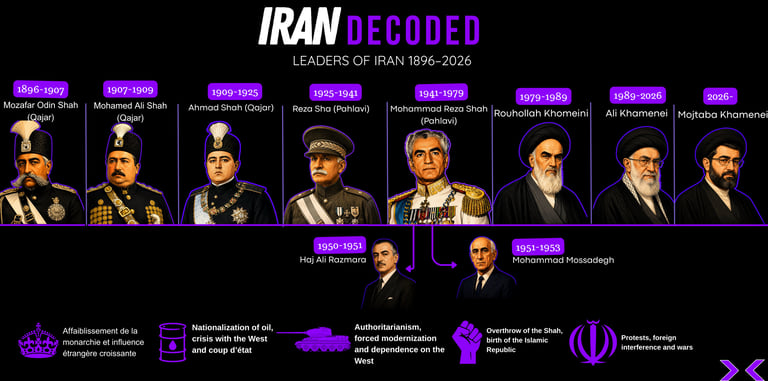
In 1925, the Pahlavi dynasty replaced the Qajars. Reza Shah abolished the capitulations in 1928, but Britain's grip on Iranian oil remained intact. In 1935, the Anglo-Persian Oil Company was renamed the Anglo-Iranian Oil Company (AIOC). That same year, the government requested that foreign countries officially refer to the nation as "Iran" rather than "Persia." The balance of power, however, remained unchanged.
Reza Shah pursued an ambitious program of modernization: railways, universities, women's emancipation, and the secularization of the state. Yet he also ruled as an authoritarian. Censorship intensified, political opponents were repressed, and political parties were banned.
On the oil question, he renegotiated the concession in 1933, only to make further concessions to the British once again.
In August 1941, the Allies invaded Iran to secure a supply corridor to the Soviet Union. Reza Shah was forced to abdicate and was sent into exile in South Africa, where he died in 1944.
His son, Mohammad Reza Pahlavi, twenty-two years old and educated in Switzerland, ascended the throne. American diplomats described him as "weak and incapable of making a decision."
V. Oil Nationalization: The Point of No Return
The Second World War fundamentally altered the global balance of power. Britain emerged victorious but financially exhausted. The United States became the dominant Western power, while anti-colonial movements gained momentum across Asia and the Middle East.
In Iran, one issue overshadowed all others: oil.
Despite producing one of the world's largest quantities of petroleum, the country received only a tiny fraction of the profits generated by the Anglo-Iranian Oil Company. Working conditions for Iranian laborers at Abadan were harsh, wages remained extremely low, and the contrast between the living standards of British employees and Iranian workers fueled growing resentment.
Calls for nationalization became increasingly widespread.
In 1951, Parliament voted overwhelmingly to nationalize the oil industry.
Mohammad Mossadegh, leader of the National Front and a fervent defender of Iranian sovereignty, was appointed Prime Minister.
His objective was straightforward: Iranian oil should belong to Iran.
For London, however, the decision was unacceptable. The British government regarded the nationalization not merely as an economic setback but as a direct challenge to its strategic interests and to the authority of the British Empire itself.
VI. AJAX: The Mechanics of a Coup
The British response was immediate.
The Royal Navy blockaded Iranian oil tankers. Iranian oil production collapsed from 664,000 barrels per day in 1950 to just 27,000 in 1952 (a decline of 96 percent). Iranian assets held in British banks were frozen. Mossadegh proposed a fifty-fifty profit-sharing agreement modeled on the Venezuelan system, but Britain refused. The British wanted to overthrow the Iranian government but no longer possessed sufficient influence inside the country to accomplish it alone. They therefore turned to the CIA. President Harry Truman refused to support a coup against a democratically elected government. Everything changed in January 1953 with Dwight D. Eisenhower's arrival in the White House. The British reframed their argument. Mossadegh was no longer portrayed as an inconvenient nationalist but as a potential gateway to Soviet communism. In April 1953, CIA Director Allen Dulles approved one million dollars for the Agency's Tehran station.
Its mission was explicit:
"Bring about the fall of Mossadegh by any means."
On July 1, Winston Churchill gave his approval. Ten days later, Eisenhower authorized the operation. Over the next three months, British and American officials met secretly in Cyprus and Beirut to finalize the plan. Its official names were TPAJAX on the American side and Operation Boot on the British side. The strategy was to make the coup appear entirely constitutional. Under Iran's Constitution, the Shah possessed the legal authority to dismiss the Prime Minister. The operation therefore aimed to persuade him to exercise that power.
Phase One: Manipulating the Press
The first stage focused on shaping public opinion.
Journalists and newspaper editors were secretly paid to publish articles attacking Mossadegh.
Rumors circulated daily, claiming that the Prime Minister was incapable of governing, intended to abolish the monarchy, or was preparing an alliance with the communist Tudeh Party.
Forged articles and fabricated stories were spread to create an atmosphere of fear and instability.
He was portrayed as an enemy of Islam, while more radical circles even fabricated claims that he was of Jewish origin.
Phase Two: Activating Internal Networks
The CIA and British intelligence then financed an extensive network of influence.
Members of Parliament, military officers, tribal leaders, politicians, and several senior clerics were approached. Some mullahs used their influence to turn public opinion against Mossadegh, denouncing him during Friday prayers.
At the same time, intermediaries recruited groups tasked with organizing demonstrations in support of the Shah and against the government.
On July 19, 1953, a discreet man entered Tehran under the alias James Lockwood.
He was Kermit "Kim" Roosevelt Jr., grandson of Theodore Roosevelt, a Harvard graduate, and a senior CIA operative.
From a secure villa, Roosevelt coordinated every aspect of the operation: financing political allies, distributing bribes, and directing the networks responsible for destabilizing the government.
Phase Three: Securing the Royal Decrees
The final step was to obtain the Shah's signature.
For several weeks, Mohammad Reza Shah refused to commit himself. He feared failure and the consequences of a direct confrontation with Mossadegh.
The Americans and the British first attempted to reach him through his twin sister, Princess Ashraf Pahlavi. She was encouraged, financially supported, and asked to persuade her brother to sign the decrees.
The attempt failed.
The Shah still refused to take the risk.
Kermit Roosevelt then took matters into his own hands.
Working in complete secrecy, he arranged a series of clandestine meetings with the Shah, sometimes inside moving cars or near the royal palace to avoid surveillance.
The pressure became constant.
Eventually, the Shah gave in.
He signed two firmans (royal decrees): the first dismissed Mossadegh as Prime Minister, while the second appointed General Fazlollah Zahedi as his replacement.
During the night of August 15–16, 1953, the first phase of the coup was launched.
Colonel Nassiri, an officer of the Imperial Guard, was ordered to deliver the royal decree dismissing Mossadegh and immediately place him under arrest.
But Mossadegh had been warned.
How he learned of the plot remains debated. It may have been the result of an internal leak, increased surveillance, or intercepted communications.
When Nassiri arrived at the Prime Minister's residence, the situation was already under control.
Instead of arresting Mossadegh, Nassiri himself was arrested by troops loyal to the government.
Elsewhere, military units expected to support the coup either hesitated or failed to act.
Coordination collapsed.
The element of surprise was lost.
Radio Tehran announced that the coup attempt had failed.
Crowds supporting Mossadegh attacked symbols of the monarchy throughout the capital.
The Shah panicked and fled first to Baghdad, then to Rome.
In Washington, the CIA sent Roosevelt a clear instruction:
"The operation has been attempted and has failed. Cease all action against Mossadegh."
Roosevelt received the order.
He ignored it.
At that moment, the operation could have ended.
Instead, he chose to continue.
Roosevelt immediately launched a far more aggressive second phase.
Thousands of copies of the royal decrees were printed and distributed across Tehran to give the overthrow an appearance of constitutional legitimacy.
Networks linked to newspapers and printing presses produced leaflets, communiqués, and articles supporting the Shah.
At the same time, an extensive propaganda campaign intensified.
Rumors spread through newspapers, political intermediaries, and religious figures portrayed Mossadegh as a threat to Islam and accused him of steering Iran toward communism.
Funds were distributed to mobilize crowds.
Local gangs and hired strongmen from working-class neighborhoods were paid to organize demonstrations, provoke violence, and create an atmosphere of chaos.
A crucial turning point came when Ayatollah Abol-Ghasem Kashani, once one of Mossadegh's closest allies, publicly broke with him and called for opposition to his government.
His defection gave the movement religious legitimacy and accelerated the country's political polarization.
The situation rapidly spiraled out of control.
Tehran descended into what increasingly resembled urban civil war, with street battles, rival groups, and military units divided in their loyalties.
August 19, 1953
On August 19, everything changed.
Crowds flooded the streets of Tehran, organized and supported by networks backing the coup.
Parts of the military joined them.
Strategic buildings quickly fell into their hands.
Mossadegh's residence came under heavy attack.
After several hours of fighting and hundreds of casualties, his government collapsed.
Mossadegh briefly escaped but eventually surrendered.
Shortly afterward, the Shah returned from Rome and reclaimed the throne.
The coup had succeeded.
Sources
Ervand Abrahamian, A History of Modern Iran
Yann Richard, L'Iran de 1800 à nos jours
Kermit Roosevelt Jr., Countercoup: The Struggle for the Control of Iran